
Why High-Quality DevOps Engineers Are in Higher Demand Than Ever (2025 Deep Dive)
The 2025 DevOps Skills Gap: How Hands-On Practice and Real-World Scenarios Create Elite Engineers

💡 You often see developers coding daily, sharpening their skills every single day. But what about DevOps engineers?
For developers, growth often means writing more code, learning new frameworks, and building projects line by line. But for DevOps engineers, excellence isn’t about typing faster — it’s about thinking smarter, troubleshooting better, and architecting systems that never fail (or recover fast when they do).
🧠 The 2025 DevOps Landscape: Demand Is High, But Quality Matters More
According to multiple 2025 market analyses, DevOps remains one of the most sought-after roles in tech — and it’s not slowing down anytime soon.
🌍 DevOps positions account for nearly 36.7% of all infrastructure-related job postings in early 2025 (DevOps Projects HQ).
💼 The role is recession-resilient, with companies continuing to hire DevOps talent despite economic slowdowns (Times of India, 2025).
📊 In the U.S., DevOps engineers rank among the top 5 most in-demand technical roles, reflecting the ongoing need for automation, reliability, and scalable systems (Statista, 2025).
Yet, there’s a growing gap between quantity and quality.
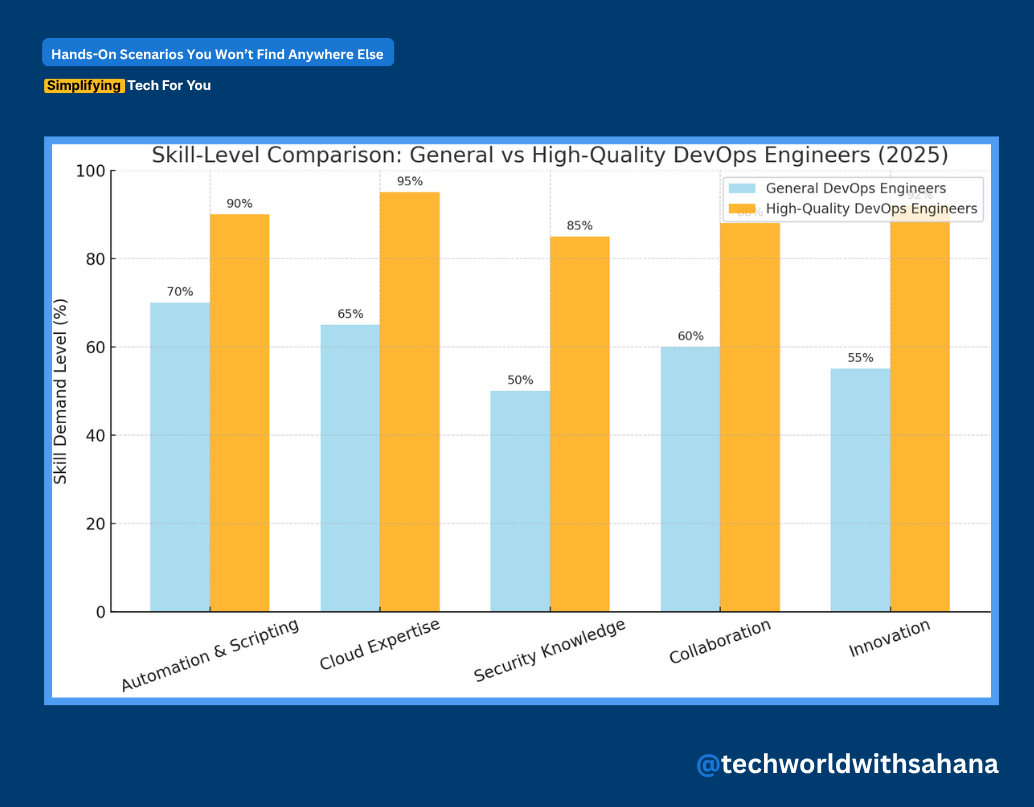
While the general demand for DevOps engineers continues to rise, the real competition — and the highest salaries — are reserved for high-quality DevOps engineers who combine technical expertise with strategic problem-solving and hands-on mastery
⚙️ What Sets High-Quality DevOps Engineers Apart
Here’s what organizations are now prioritizing:
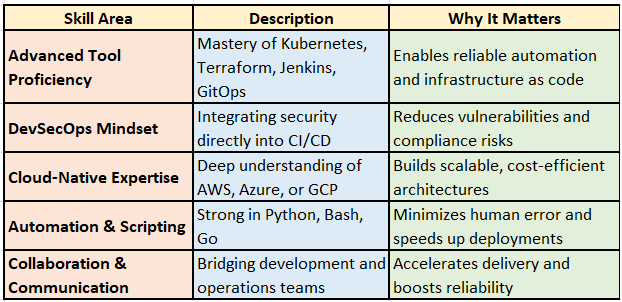
In short: a great DevOps engineer doesn’t just deploy — they design, secure, and continuously improve.
📚 Related Playlists & Courses
🔗 Playlist 1: Module 1 - Kubernetes Real World Scenario Based Questions
🔗 Playlist 2: Module 2 - Kubernetes Failures and Fixes
🎓 Kubernetes Crash Course - Kubernetes Zero To Interview Hero
🔥 The Hidden Skill: Scenario-Based Thinking
Here’s the secret most junior DevOps engineers overlook:
Your biggest growth comes from practicing failure.
Unlike traditional coding, where progress is often linear, DevOps mastery is about handling chaos — system outages, scaling challenges, and performance bottlenecks.
That’s where scenario-based learning comes in.
Imagine being asked:
“Your Kubernetes pod keeps crashing with an
OOMKillederror — what’s your approach?”“How would you design a zero-downtime deployment strategy for a microservices-based system?”
“A CI/CD pipeline suddenly doubles its runtime — how do you investigate and fix it?”
These real-world questions test not only your technical understanding but also your ability to think clearly under pressure — exactly what top companies are hiring for.
🧩 Hands-On Practice: The Real Key to Growth
High-quality DevOps engineers practice daily — not necessarily by writing thousands of lines of code, but by experimenting, breaking things, and fixing them.
✅ Build clusters.
✅ Deploy apps.
✅ Simulate outages.
✅ Fix bottlenecks.
✅ Automate repetitive tasks.
Every small experiment strengthens your muscle memory for production-grade problem-solving.
“The best DevOps engineers are not those who never fail — they’re the ones who know exactly what to do when failure happens.”
💡 Ready to Sharpen Your Skills?
Here’s a great place to start:
🎯 10 Kubernetes Real-World Questions Solved in 15 Minutes | Hands-On for DevOps Interviews (Set-2)
📺 Watch:
These hands-on scenarios are designed to challenge your real-world thinking and prepare you for both interviews and day-to-day engineering work.
📊 DevOps Demand in 2025: A Visual Snapshot
Below is a simple visualization of the overall DevOps job market versus the growing niche of high-quality DevOps engineers:
(Representation based on 2025 industry reports — showing that while general demand dominates, the high-quality segment is rapidly expanding and far more valued.)
🧭 Final Thoughts: The Path to Becoming a High-Quality DevOps Engineer
If you’re in DevOps today, remember this:
You don’t have to code all day to grow — but you do have to practice every day.
Build, break, fix, and repeat.
That’s the DevOps way.
And it’s exactly why high-quality engineers — the ones who stay hands-on and problem-focused — will always be in the highest demand.
Your future self (and your career) will thank you. 🚀
I completely agree with your emphasis on safe experimentation and continuous learning in DevOps—it’s exactly what modern teams need. From what I’ve seen at my company, creating that culture means more than just saying “fail fast.” You also need the infrastructure, the processes, and the freedom to recover without risking client trust.
At Genetech we’ve turned this into practice by embedding load-balancing, uptime monitoring and rollback safety into every DevOps deployment. What that does is give our teams the confidence to try new things—knowing the system is protected, they can innovate. In the era of cloud hosting (rather than legacy conventional hosting) we’ve moved from fear of failure to structured experimentation, and that’s how we keep delivery fast and reliable.
Let’s keep building DevOps teams where failures are visible, recoveries are fast, and learning never stops.