
What is Artificial Intelligence? A Beginner’s Guide to AI, Machine Learning & Smart Machines
From Google Maps to Netflix: Understanding how AI is learning to think like humans—and why it matters for you

Today we’re diving into one of the most transformative technologies of our time: Artificial Intelligence. Whether you realize it or not, AI is already shaping your daily life—from the routes your GPS suggests to the shows Netflix recommends. But what exactly is it? And how does it work?
Let’s break it down in simple, easy-to-understand terms.
What is Artificial Intelligence?
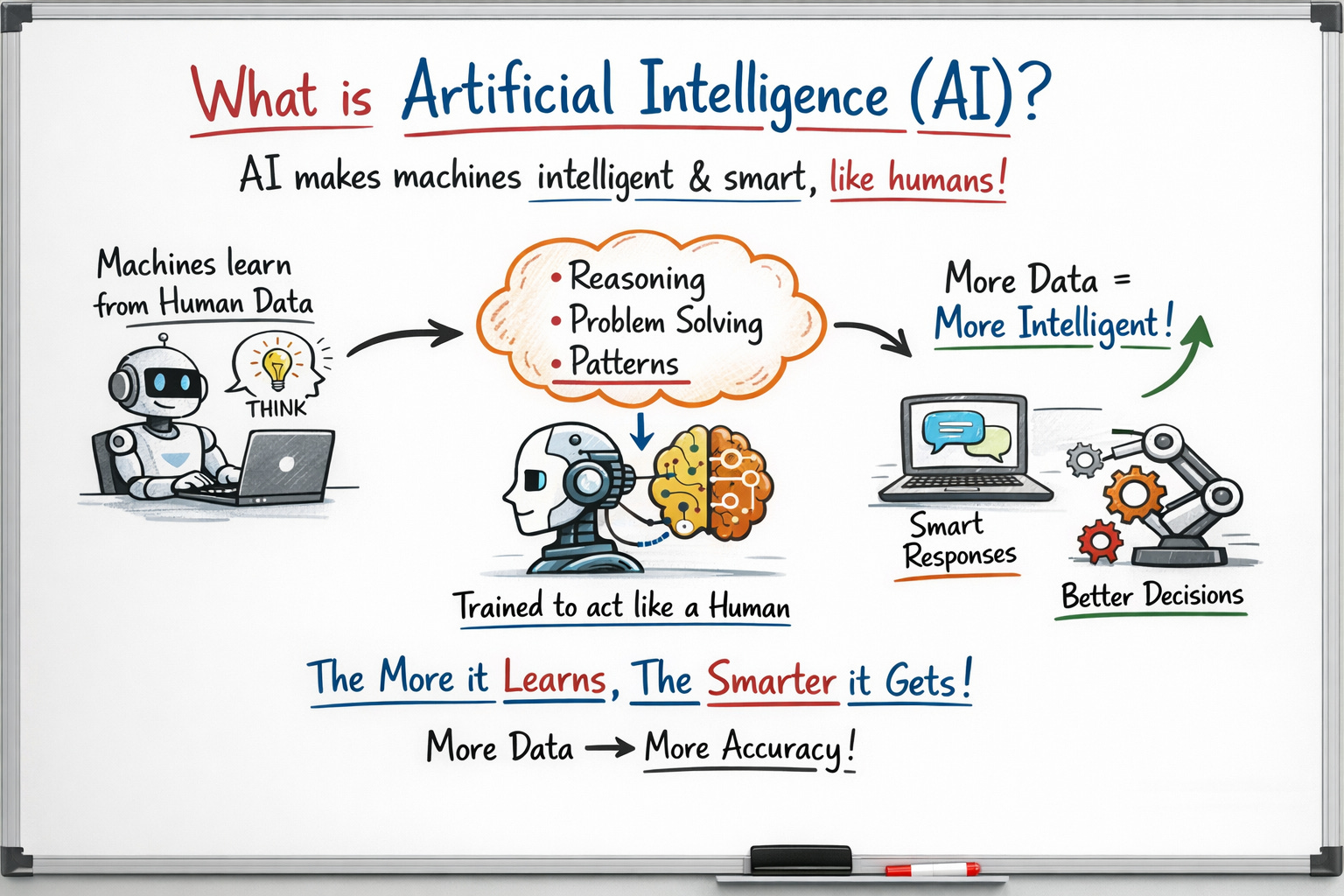
At its core, Artificial Intelligence is a type of science that makes machines intelligent and smart. It gives computers or machines the ability to work like human intelligence.
Here’s the key insight: AI doesn’t just follow pre-programmed instructions. Instead, machines collect human data and use it for reasoning, problem-solving, and understanding patterns. With the help of this data, machines are trained so that their responses become as intelligent as humans.
And here’s the best part—over time, this system keeps improving. The more data it collects, the more its accuracy increases. It’s like teaching a child: the more experience they gain, the smarter they become.
Real-World Examples of AI You Already Use
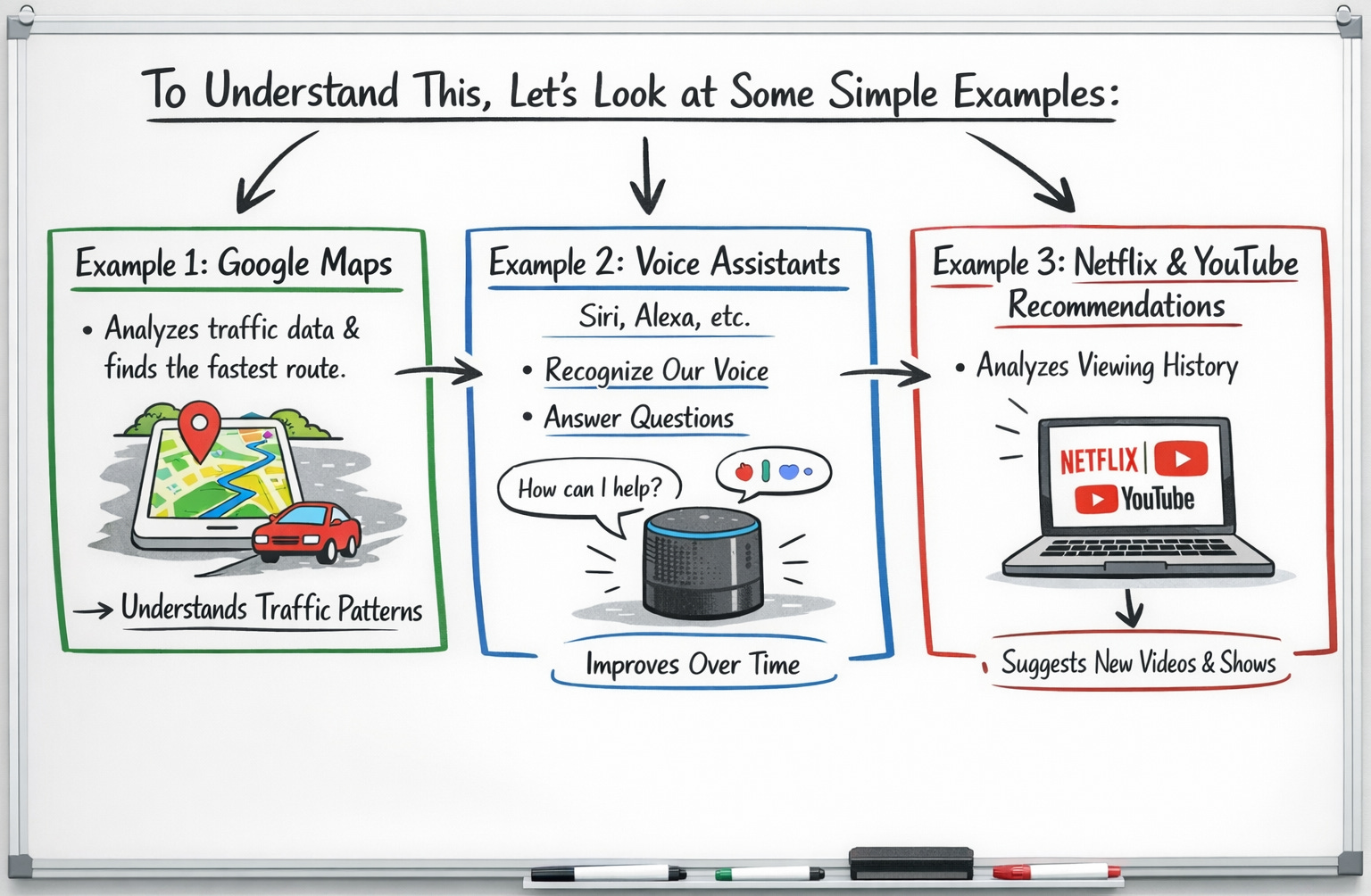
Example 1: Google Maps
Ever wondered how Google Maps always seems to know the fastest route? That’s AI in action.
Google Maps uses AI to analyze traffic data and show you the fastest route. It understands patterns like which roads are busy at what time, learns from millions of daily commutes, and continuously improves its recommendations. The more people use it, the smarter it gets.
Example 2: Voice Assistants
Siri, Alexa, Google Assistant—these are all powered by AI.
Voice assistants understand our voice, answer questions, and their responses improve over time. When you talk to Siri, she’s not just matching pre-recorded responses. She’s analyzing your speech patterns, understanding context, and learning from every interaction to respond more accurately next time.
Example 3: Netflix and YouTube Recommendations
Have you noticed how Netflix always seems to know what shows you’ll love? Or how YouTube’s “Recommended for You” section feels oddly accurate?
That’s AI working behind the scenes. These platforms analyze your past activity, understand patterns, and suggest new videos or shows based on that. The algorithm learns what you like, predicts what you’ll enjoy next, and gets smarter with every video you watch or show you rate.
Common AI-Related Terms You Should Know
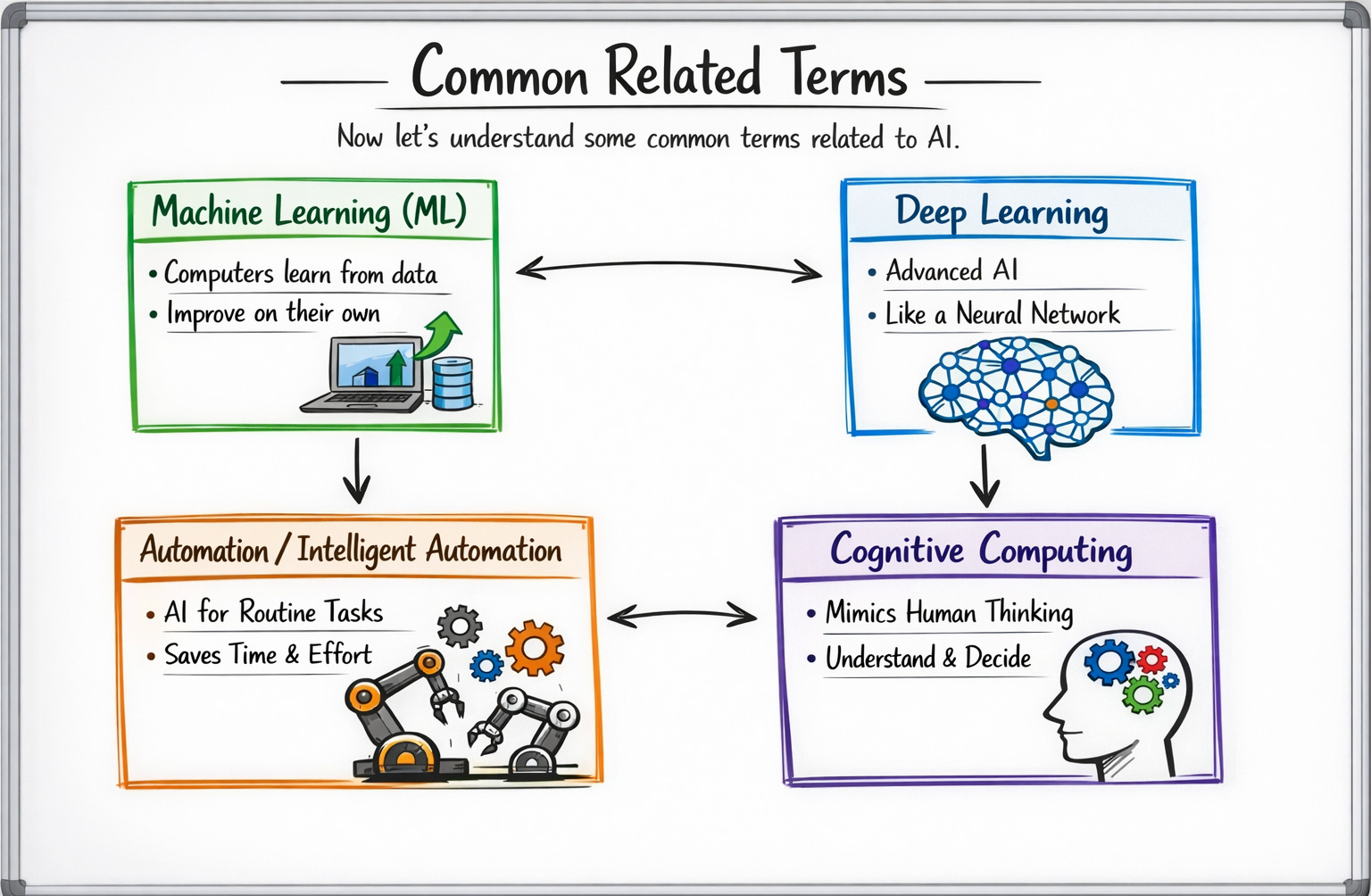
As you explore the world of AI, you’ll encounter some technical terms. Here’s what they mean in simple language:
Machine Learning (ML)
Machine Learning is a process where computers are taught to learn from data, meaning they keep improving on their own without being explicitly programmed.
Instead of writing thousands of lines of code to handle every scenario, we feed machines data and let them figure out the patterns themselves. It’s like learning to ride a bike—you don’t need instructions for every wobble; you learn through practice.
Deep Learning
Deep Learning is an advanced part of AI that works like the human brain’s neural network and helps in understanding complex patterns.
Think of it as AI’s superpower. Deep Learning can recognize faces in photos, understand written text in images, and even generate human-like responses. It mimics how our brains process information through interconnected networks.
Automation / Intelligent Automation
Automation or Intelligent Automation uses AI to perform repetitive and routine tasks automatically, saving both time and effort.
From chatbots answering customer service questions to robots assembling products in factories, intelligent automation frees up humans to focus on more creative and strategic work.
Cognitive Computing
Cognitive Computing refers to systems that try to mimic human thinking processes, meaning they develop the ability to understand, think, and make decisions.
These systems can understand context, reason through problems, and interact with humans in natural, conversational ways. They’re like having a knowledgeable colleague who can think through complex problems with you.
How Does AI Actually Work?
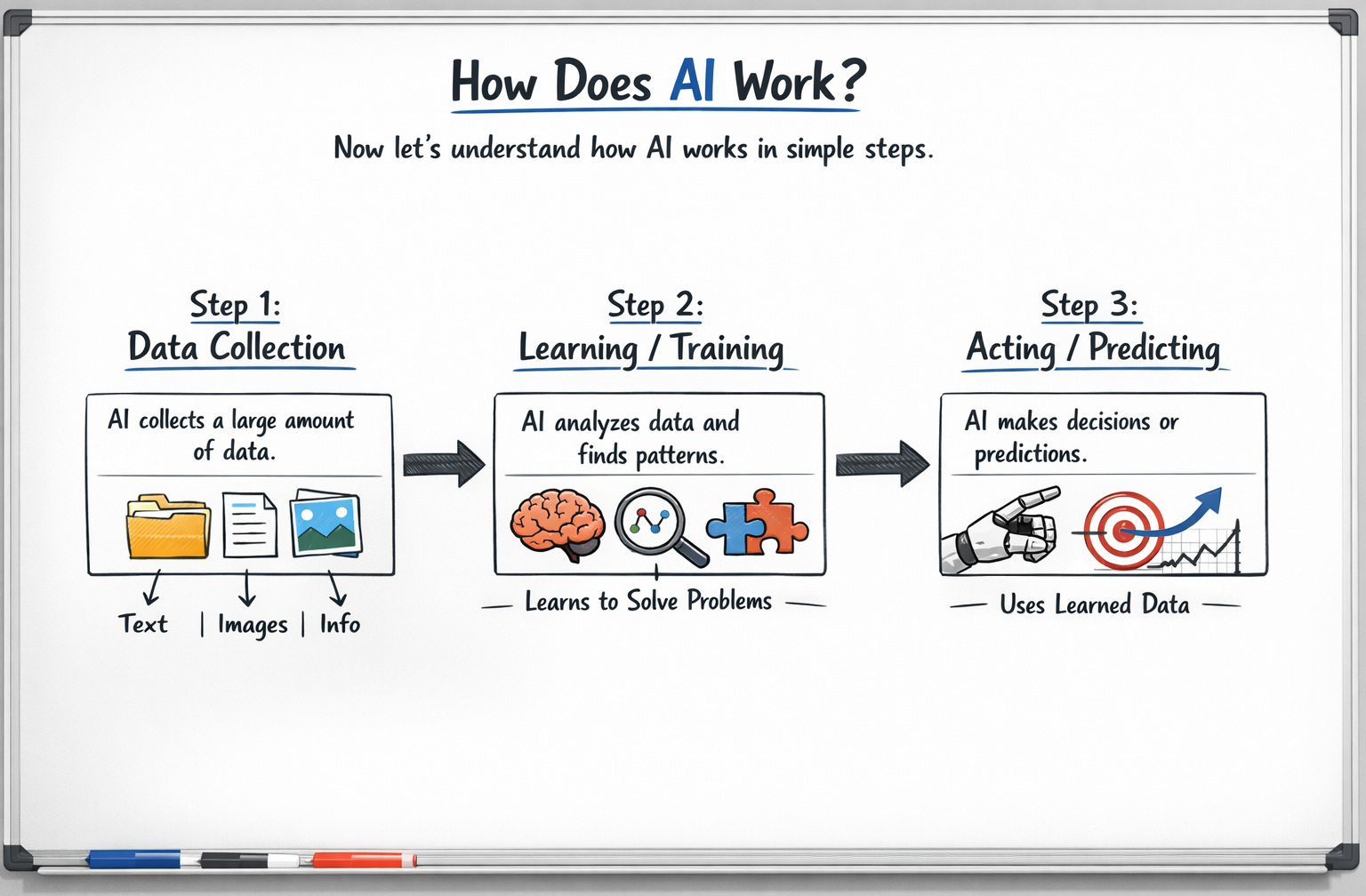
Now let’s demystify the process. AI doesn’t just magically become smart. Here are the three essential steps:
Step 1: Data Collection
The first step is collecting a large amount of data, such as text, images, or other information.
This is where everything starts. Whether it’s millions of photos for a facial recognition system or years of traffic patterns for Google Maps, AI needs massive amounts of quality data to learn from. The more data, the more patterns it can identify.
Step 2: Learning / Training
In this step, AI analyzes the data and learns patterns to understand how to solve problems.
This is where the “intelligence” actually develops. AI algorithms examine the data, identify what patterns lead to correct answers, and gradually adjust themselves to improve their accuracy. It’s similar to how you might study for a test—the more problems you practice, the better you understand the material.
Step 3: Acting / Predicting
In the final step, AI uses its learning to make decisions or predictions on new data.
Once trained, AI can take completely new information it’s never seen before and apply what it learned to make intelligent decisions. Google Maps predicts your fastest route. Netflix suggests shows. Your email filters out spam. All because of this final step.
Why Should You Care About AI?
AI isn’t just a buzzword—it’s reshaping industries, creating new jobs, and solving real-world problems. From healthcare (diagnosing diseases) to finance (detecting fraud) to education (personalized learning), AI is everywhere.
Understanding AI today prepares you for tomorrow’s world. Whether you’re a student, professional, or business owner, AI literacy is becoming as essential as digital literacy.
👉 Watch the full video to explore real-world AI examples and master the fundamentals →
In the video, we dive deeper into:
How AI learns from data step-by-step
More complex examples of AI in action
The future of artificial intelligence
How AI will impact your career and life
Don’t just read about AI—watch the complete explanation and see it come to life.
Have questions about AI? Share them in the comments below. Let’s build an AI-literate community together!
Subscribe to stay updated with more AI insights, explained simply.